
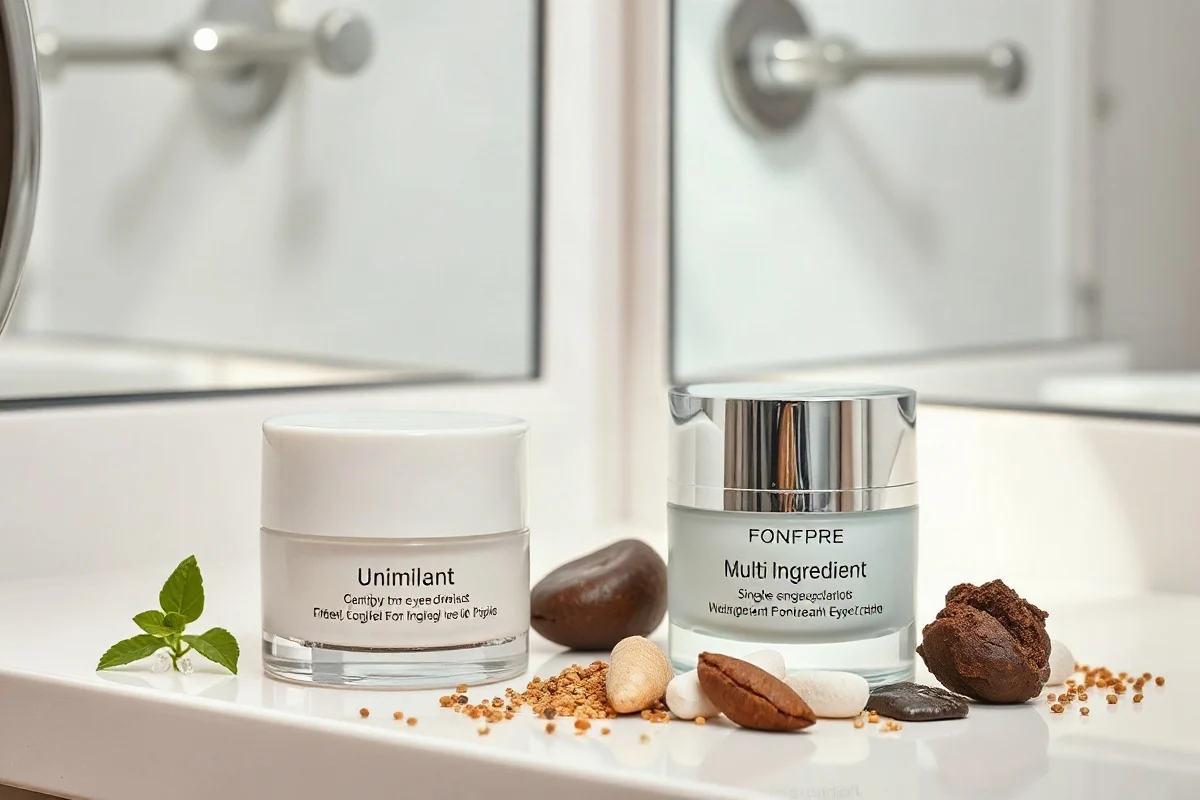
Neither single-ingredient nor multi-ingredient eye creams are automatically better. A single-ingredient formula may make it easier to identify what your skin likes or dislikes, while a well-designed multi-ingredient formula can address several appearance concerns at once. The better choice depends on your primary concern, skin sensitivity, current routine, and whether you prefer a simple product or a more comprehensive formula.
What “single-ingredient” really means
A single-ingredient eye cream usually refers to a product marketed around one prominent or “hero” ingredient, such as caffeine, retinol, vitamin C, hyaluronic acid, or a peptide. It does not necessarily mean the formula contains only one ingredient. A cream still needs a base made from ingredients that provide texture, stability, preservation, and spreadability.
For that reason, read “single-ingredient” as a description of the product’s main focus rather than a literal list containing only one substance. The complete ingredient list remains important, especially if you have sensitive skin, allergies, or a history of reacting to fragrance or preservatives.
Why a focused formula can be appealing
- Easier product comparison: You can quickly identify the formula’s main purpose and compare similar options.
- Simpler troubleshooting: If irritation or discomfort occurs, it may be easier to investigate the product’s key active and the rest of the ingredient list.
- Less routine overlap: A focused formula may be easier to combine with products already used on the rest of the face.
- Clearer expectations: You can select a product based on one main cosmetic goal rather than several broad promises.
A focused formula is not automatically gentler or more effective. A single active can still be irritating, particularly around the eyes. The strength, delivery system, supporting ingredients, and your own skin tolerance all matter.
What a multi-ingredient eye cream offers
A multi-ingredient formula combines several ingredients intended to support different aspects of the under-eye area. For example, a product might include moisturizing ingredients for dryness, humectants for a temporarily smoother look, and an ingredient chosen for the appearance of puffiness. Other formulas may combine an antioxidant, a barrier-supporting ingredient, and a texture-enhancing emollient.
The advantage is convenience. Instead of building a routine around several separate products, you may be able to use one eye cream that fits more than one cosmetic goal. This can be useful when dryness makes fine lines look more noticeable, or when the under-eye area looks dull and tired while also feeling tight.
However, a longer ingredient list can make it harder to determine which ingredient is responsible for improvement, discomfort, or no noticeable change. It can also increase the chance that the formula contains something your skin does not tolerate. More ingredients do not guarantee a stronger or more meaningful result.
Match the formula to the concern
Choosing between these formats becomes easier when you separate the appearance concern from the product category. Dark circles, puffiness, dryness, and fine lines do not all have the same visible causes, and an eye cream cannot address every cause equally.
For the appearance of dark circles
Dark circles can look different from person to person. Under-eye darkness may appear brown, gray, blue, or purple, and shadows caused by facial structure can look different from changes in skin tone. An eye cream may improve hydration, surface brightness, or the look of dullness, but it may not change the appearance of every type of darkness.
If your main concern is a tired-looking or dull under-eye area, you might compare formulas featuring brightening-supportive or antioxidant ingredients. Vitamin C derivatives are used in some cosmetic products, but forms and formulas vary. If you are considering a retinol eye cream, remember that retinoids can be irritating and should be introduced cautiously according to the product label. For broader background, see our eye cream ingredient guide.
Cosmetic care is different from diagnosing or treating a medical condition. If discoloration is new, one-sided, rapidly changing, associated with other symptoms, or concerning to you, seek guidance from a qualified health professional rather than relying on an eye cream.
For puffiness and under-eye bags
Multi-ingredient formulas may appeal to shoppers who want a product that combines moisturizing, smoothing, and de-puffing-focused ingredients. Caffeine is commonly used in products marketed for the appearance of puffiness, although the visible effect can depend on the individual and may be temporary. Cooling applicators and lightweight textures can also make the area feel refreshed without changing the underlying cause of bags.
Puffiness can vary with sleep, crying, allergies, fluid retention, skin irritation, and facial anatomy. An eye cream may help the area look more hydrated or temporarily less tired, but it should not be presented as a treatment for an underlying medical issue. You can explore more appearance-focused guidance in our coverage of puffiness and eye bags.
For dryness and fine lines
If the skin feels tight or looks creased because of dryness, a moisturizing formula may be the most practical starting point. Humectants such as glycerin or hyaluronic acid can help attract water to the skin’s surface, while emollients and occlusive ingredients can support a softer, more comfortable feel. These effects may temporarily make fine lines look less prominent by improving surface hydration.
For visible fine lines, some shoppers prefer a formula with a retinoid or peptide-focused approach. Retinoid products require extra care around the delicate eye area and may not suit everyone. Follow the label, introduce the product gradually if permitted, avoid getting it in the eyes, and stop using it if persistent burning, swelling, rash, or significant irritation develops. For a broader comparison of concerns, visit our guide to fine lines and wrinkles around the eyes.
Single-ingredient versus multi-ingredient: a practical comparison
| Consideration | Single-ingredient-focused formula | Multi-ingredient formula |
|---|---|---|
| Best for | Shoppers with one main concern or those who prefer a focused routine | Shoppers with several overlapping concerns who want one convenient product |
| Ingredient tracking | Usually easier to identify the main active or focus | Requires closer reading of the full ingredient list |
| Routine simplicity | Can be easy to add without duplicating other actives | May reduce the number of separate products needed |
| Irritation troubleshooting | May be more straightforward, but the featured active can still irritate | May be more complicated because several ingredients are present |
| Expected outcome | Usually centered on one cosmetic goal | May support several cosmetic goals, without guaranteeing stronger results |
How to choose when you have sensitive skin
Sensitive skin does not automatically require a single-ingredient product, and a multi-ingredient formula is not necessarily unsuitable. Instead, look for a short, understandable ingredient list and consider avoiding known triggers. Fragrance, essential oils, exfoliating acids, and retinoids may be poorly tolerated by some people, while others may use them without difficulty. Individual response varies.
Apply a small amount to an inconspicuous area before using a new product near the eyes, when the label allows for patch testing. Follow the package directions, keep the product out of the eyes, and do not apply it to broken or actively irritated skin unless a qualified professional advises you to do so. Stop using the product if you develop persistent stinging, redness, swelling, rash, or other concerning symptoms.
For sensitive skin, it is often helpful to change only one product at a time. Using several new actives together makes it difficult to know what caused a reaction. A basic moisturizer designed for the eye area may be a more sensible first step than immediately choosing a formula with multiple strong-looking actives.
Read the full label, not only the front of the package
Marketing language can make a product sound either highly targeted or impressively comprehensive, but the front label does not tell the whole story. Check the current ingredient list, directions, warnings, and intended area of use. Ingredient order can provide context, but it does not tell you exactly how well a product will perform for your skin.
Formulas can change over time. Before buying or using a product, verify the current packaging or the manufacturer’s ingredient information, especially if you are avoiding a specific ingredient. Product names and marketing claims may remain familiar even when a formula has been updated.
Application matters more than adding more products
Use a small amount and apply it gently along the orbital area, following the product’s directions. Avoid rubbing, tugging, or applying too close to the eye opening. If a product pills under sunscreen or makeup, using less or allowing earlier layers to settle may help, although the formula’s texture is also a factor.
Consistency is more useful than constantly switching between formulas. Give a product reasonable time to show whether it improves hydration or the cosmetic appearance of the area, while keeping expectations realistic. If you use an active product, introduce it carefully rather than layering several potentially irritating products at once.
The most useful choice is the one you can evaluate
Choose a single-ingredient-focused eye cream when you have one clear priority, want a simpler ingredient story, or are trying to identify what your skin tolerates. Choose a multi-ingredient formula when you want convenience and your concerns overlap, provided the ingredients and directions fit your routine.
In either case, judge the formula by its complete label, texture, tolerance, and realistic cosmetic purpose—not by the number of highlighted ingredients. No eye cream can guarantee that dark circles, puffiness, or fine lines will disappear, and a more complicated formula is not automatically a better one. The strongest routine is usually the one you understand, use as directed, and can continue without irritating the delicate under-eye area.

Comments
0No comments yet. Be the first to share a helpful note or question.
Leave a Comment
Your email address will not be published. Comments are reviewed before appearing on the site.