
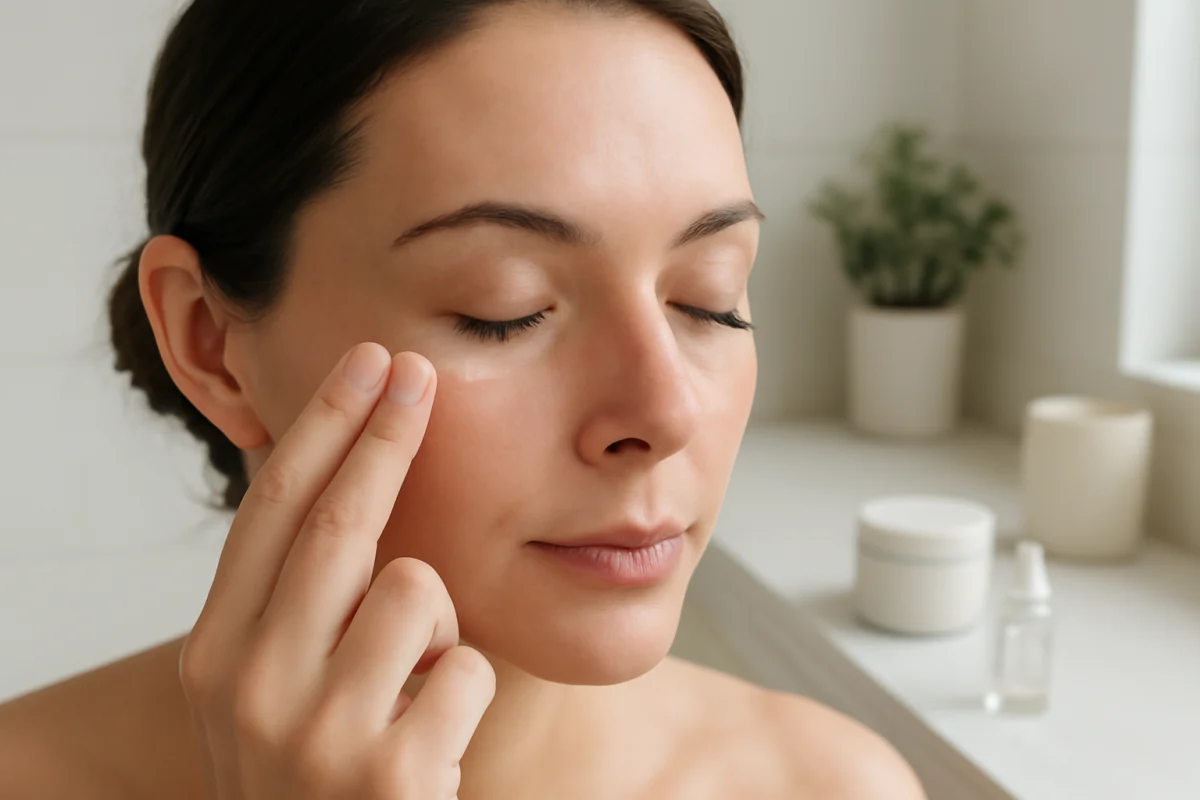
Apply eye cream to the orbital area: the skin beneath your eyes, along the outer corners, and on the brow bone just below the eyebrows. Use a small amount and gently tap it onto clean, dry skin without bringing the product directly onto your eyelids, lash line, or eyes. The warmth of your skin can help the product spread, so more is not necessarily better.
Although the application area sounds simple, many people either place eye cream too close to the eye or stop too far away to address the area they want to moisturize. A careful technique can make the routine more comfortable and help you use the product as intended. It can also reduce unnecessary tugging on the delicate skin around the eyes.
Where eye cream belongs
The orbital area is the ring of skin surrounding the eye socket. For most eye creams, that means applying a thin layer to these areas:
- Under the eyes: Start below the lower lash line and work outward over the hollow or upper cheek area where the product can be comfortably spread.
- Outer corners: Gently tap around the skin commonly called the crow's-feet area, staying on the bony area rather than pressing into the eye itself.
- Brow bone: Apply along the skin beneath the eyebrows, where the orbital bone can provide a natural guide.
- Upper orbital area: If the product label says it can be used there, you may apply a very small amount to the skin above the crease and below the brow bone.
A useful rule is to keep the product on the surrounding skin, not on the wet inner rim of the eye or directly against the lashes. Eye creams can migrate as you blink, move, or warm up during the day. Leaving a small buffer around the eye can make that less likely.
Where to avoid applying it
Eye cream is not meant to be placed inside the eye, on the waterline, or directly over the eyeball. Avoid rubbing it into the lash line unless the product specifically provides different instructions. The eyelids also deserve caution. Some formulas are labeled for the upper eyelid, while others are intended only for the under-eye area.
Read the product directions before using it on the lids. If the label does not mention the eyelids, apply the product to the surrounding orbital skin instead. Keep the container clean, avoid touching the applicator to your eye, and do not continue using the product if it causes persistent stinging, redness, itching, swelling, or discomfort.
The skin near the eyes can react to products that are comfortable elsewhere on the face. If you have sensitive skin, review our guide to eye care for sensitive skin and introduce one new product at a time. A small patch test can help you notice a reaction before applying a new formula around both eyes, although patch testing cannot guarantee that irritation will not occur.
How much eye cream should you use?
For many formulas, a rice-grain-sized amount for both eyes is a reasonable starting point, but the correct amount depends on the product's texture and directions. Some lightweight gels spread farther than rich balms, and some applicators dispense more product than you need. Follow the package instructions rather than assuming that a larger amount will produce better cosmetic results.
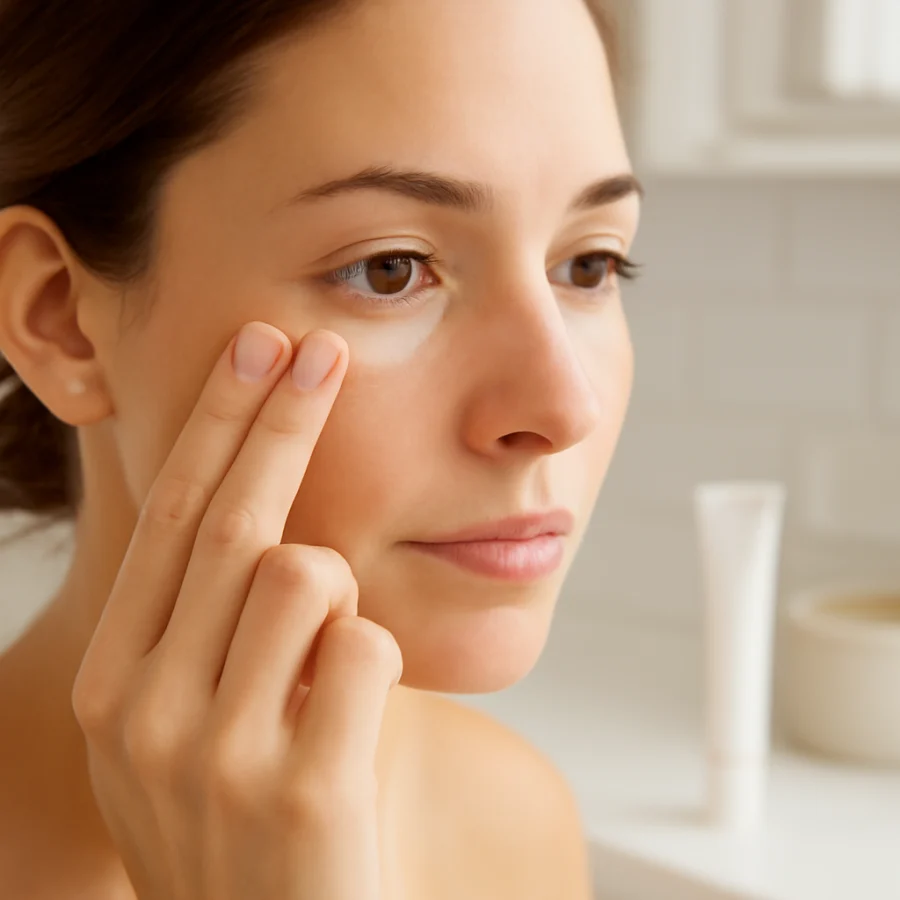
Using too much can create practical problems. Excess product may feel heavy, pill under makeup, migrate toward the eyes, or make the area look shiny. A thin, even layer is usually easier to tolerate and easier to layer with moisturizer and sunscreen.
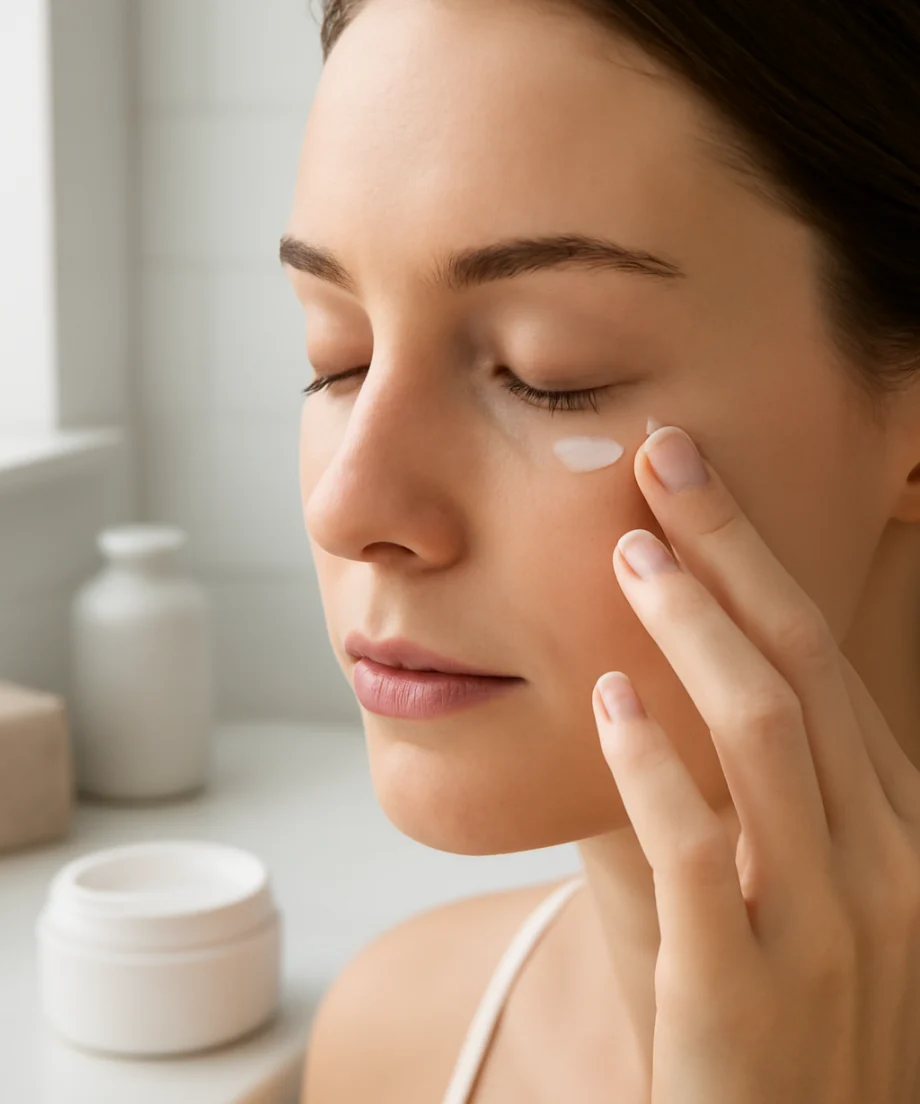
Place a tiny dot at several points instead of depositing one large blob in one location. For example, you might use small dots beneath each eye and at the outer corners, then gently connect them with light tapping. This approach can help distribute the formula without dragging the skin.
How to apply eye cream without tugging
- Cleanse gently. Remove makeup and sunscreen without scrubbing the eye area. Pat the skin dry with a soft towel.
- Use clean hands. Wash your hands before touching the product or the skin around your eyes.
- Start with a small amount. Add more only if you need it to cover the recommended area.
- Place small dots. Tap the formula beneath the eyes, around the outer corners, and along the brow bone if the directions allow.
- Press and release. Use your ring finger or another finger that lets you apply a light touch. Avoid rubbing back and forth.
- Give it a moment. Allow the product to settle before applying concealer, moisturizer, or sunscreen.
The goal is not to massage the product until it disappears. Instead, gently spread it over the skin and stop once the area is evenly coated. If the formula remains visibly wet after a short wait, you may have used more than necessary.
Should you apply eye cream before or after moisturizer?
In many routines, eye cream goes after cleansing and lightweight water-based products but before a face moisturizer. This order lets you apply the eye product precisely before a larger amount of moisturizer is spread across the face. However, the product's texture and directions matter more than a rigid rule.
If your eye cream is rich, you may prefer applying it after a lighter serum and before sunscreen in the morning. If it is a simple moisturizing formula and your face moisturizer is also comfortable around the eyes, you may not need both products on the same area. In the daytime, finish with broad-spectrum sunscreen on the surrounding face and any area where the sunscreen label permits use, while avoiding direct contact with the eyes.
At night, apply treatment products according to their directions. If you use a retinoid, exfoliating acid, or another potentially irritating active, check the label carefully and introduce it gradually. Do not assume that a face product is appropriate for the eye area simply because it works elsewhere. If burning or irritation develops, stop using the product and allow the skin to recover.
Adjusting application for common under-eye concerns
For the appearance of dark circles
Apply eye cream across the under-eye area where discoloration appears, but keep the product away from the eye itself. Eye cream may support a more hydrated, smoother-looking surface, and some formulas contain ingredients selected for the cosmetic appearance of uneven tone. Results vary, and a cream may not change every type of dark circle.
Dark circles can have several visible contributors, including shadows from facial structure, surface dryness, visible blood vessels, or naturally deeper pigmentation. A topical product cannot be expected to address every contributor. If discoloration is new, rapidly changing, accompanied by other symptoms, or concerning to you, a qualified medical professional can help determine whether it needs evaluation.
For puffiness
Use a very thin layer around the puffy area and avoid pressing firmly. Heavy application or vigorous massage can feel uncomfortable and may make the area look more swollen temporarily. A cooling applicator may feel pleasant, but it does not guarantee a lasting change in the appearance of puffiness. For more information, see our coverage of puffiness and eye bags.
For fine lines and dryness
Place the product over the dry skin beneath the eyes and along the outer corners, using light tapping rather than stretching the skin. Hydration can temporarily make fine lines look less noticeable by improving the appearance of surface smoothness. That cosmetic effect should not be confused with permanently removing wrinkles.
A moisturizer with a comfortable, compatible texture may be just as useful for dryness as a separate eye product. If you are comparing formulas for fine lines, focus on the full ingredient list, directions, packaging, and your skin's tolerance rather than relying on a dramatic promise. Product formulas can change, so verify current details on the package or the manufacturer's ingredient list.
Does eye cream go on the eyelids?
Sometimes, but only when the product directions permit it. The upper eyelid is especially close to the eye and may be more prone to irritation or product migration. If the label says the cream is suitable for the upper eyelid, use an extremely small amount and keep it away from the lash line and inner eye. If the label does not mention the eyelid, leave it out of your application area.
Do not use an eye cream on the eyelid when the skin is already irritated, cracked, or unusually sensitive. Avoid applying it over an active rash or other unexplained skin change. Cosmetic skincare guidance cannot diagnose the cause of those symptoms.
Common application mistakes
- Applying too close to the eye: Product can migrate and cause watering or stinging.
- Using too much: A thick layer may feel heavy, crease, or pill beneath makeup.
- Pulling the skin: Repeated rubbing can create unnecessary friction and discomfort.
- Skipping the label: Ingredients, intended application areas, and use instructions vary by formula.
- Layering too many strong products: Combining several potentially irritating actives near the eyes can increase the chance of discomfort.
- Expecting immediate transformation: Moisture can improve the look of dryness, but it cannot guarantee a change in the underlying reason an area appears dark or puffy.
A simple placement map
Think of the eye area as three zones. The first is the lower orbital area, extending from just below the lash line toward the upper cheek. The second is the outer corner, where you can tap around the bony edge. The third is the brow bone, where you can apply the product if the directions allow it. Leave the wet inner rim, eyeball, and immediate lash line alone.
This map works for most basic moisturizing eye creams, but it is not a substitute for the product label. A formula designed for a specific concern may have different instructions. For ingredient background, you can consult the site's eye cream ingredient guide, then confirm the current product information on its packaging or manufacturer's website.
When to simplify your routine
If the eye area feels tight, itchy, watery, or irritated, simplify the routine. Pause newly introduced products, avoid scrubbing, and use only products that you already know your skin tolerates. Do not keep applying a formula in the hope that irritation will disappear. Seek medical advice for severe, persistent, painful, or vision-related symptoms.
For everyday use, the most dependable approach is modest: apply a small amount to the orbital skin, stay clear of the eye and waterline, tap rather than rub, and follow the label. Eye cream can support the appearance and comfort of the surrounding skin, but it is not a diagnosis or treatment for an eye condition. Consistent, gentle application is more useful than applying a large amount or trying to cover every part of the eyelid.




Comments
0No comments yet. Be the first to share a helpful note or question.
Leave a Comment
Your email address will not be published. Comments are reviewed before appearing on the site.